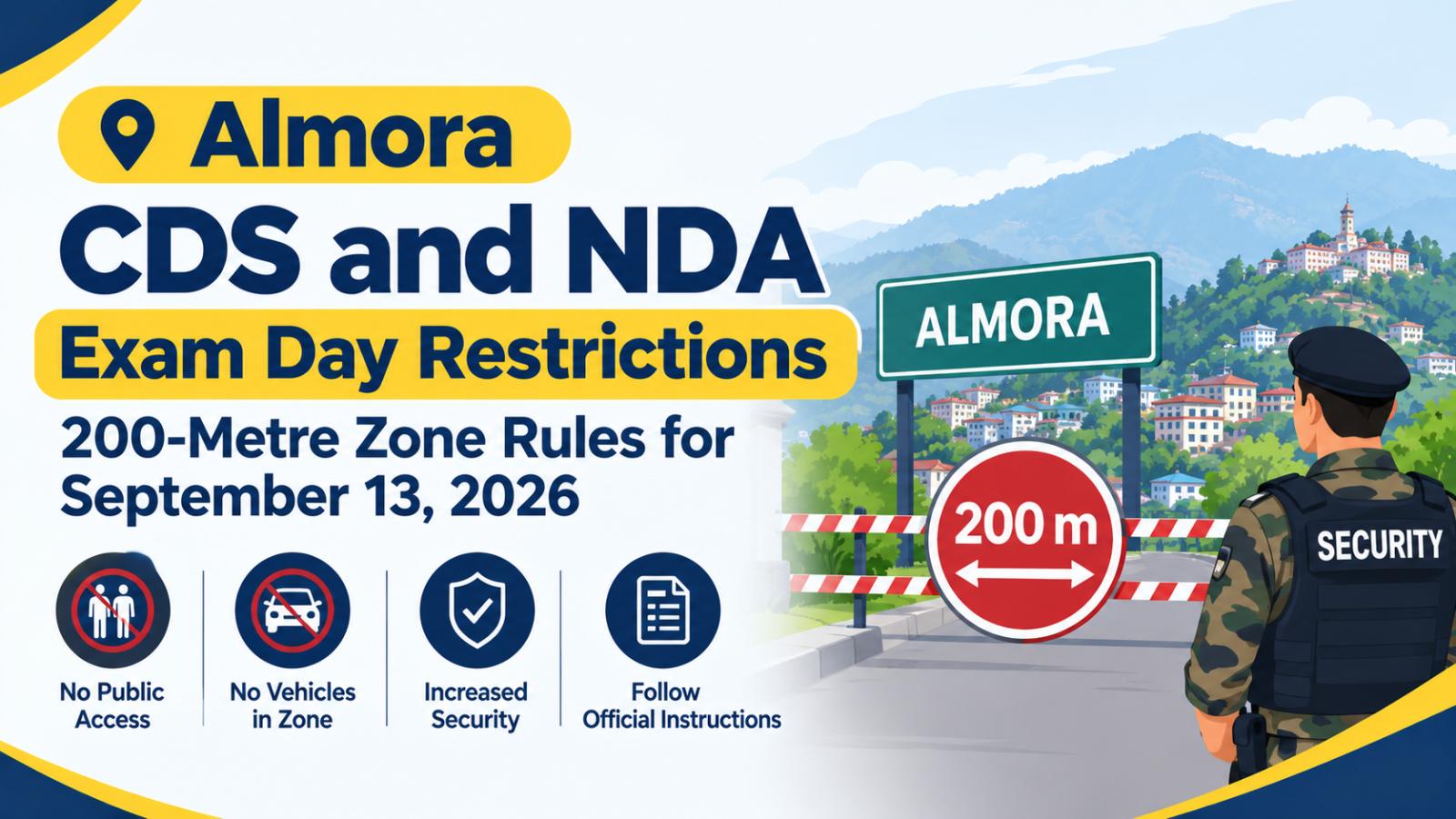
Defence aspirants appearing for the Combined Defence Services (CDS) and National Defence Academy (NDA) examinations in Almora on September 13, 2026 will face strict security arrangements around every designated centre. The district administration has issued a formal order under Section 163 of the Bharatiya Nagarik Suraksha Sanhita (BNSS), placing a 200-metre restricted zone around each venue from 9 am to 6 pm.
The move is aimed at ensuring a calm, secure, and distraction-free environment for thousands of candidates who travel to Uttarakhand’s hill districts each year for competitive examinations conducted by the Union Public Service Commission (UPSC). With CDS and NDA being among India’s most sought-after defence entry routes, even minor disruptions near exam gates can affect reporting times, document verification, and candidate confidence.
This guide explains what the Almora order means in practical terms for candidates, parents, coaching centres, and local residents and how to prepare so that exam day runs smoothly.
Why Almora Has Imposed Exam-Day Restrictions
Competitive examinations such as CDS and NDA attract large numbers of candidates, accompanying family members, coaching staff, and local onlookers. In smaller towns and tier-2 cities like Almora, exam centres are often located near markets, residential lanes, or government campuses where foot traffic is naturally high.
District authorities use preventive orders to reduce risks that commonly arise on high-stakes exam days:
Overcrowding at entry gates slows identity checks and frisking.
Unauthorized persons near centres can create confusion about reporting queues.
Carrying of weapons or improvised objects increases safety concerns.
Group gatherings and loud public activity can disturb candidates during sensitive exam hours.
Sub-Divisional Magistrate Sanjay Kumar issued the Almora order specifically for the CDS and NDA schedule on September 13. Similar restrictions are routinely notified in other districts across India before major national examinations, though the exact radius, timing, and clauses may vary.
What Section 163 BNSS Allows Authorities to Do
Section 163 of the BNSS empowers magistrates to issue directions to prevent obstruction, annoyance, injury, or risk to human life during public events or situations where immediate preventive action is required. On exam days, this legal framework helps police and civil administration manage movement around centres without waiting for an incident to occur.
For candidates, the important takeaway is simple: treat the area around your centre as a controlled zone, not a regular public space, for the duration of the order.
The 200-Metre Zone: Who Can Enter and Who Cannot
The core rule in the Almora notification is a 200-metre restriction radius around each CDS and NDA examination centre. Persons who are not connected with the examination may not enter this zone during the notified hours.
The restriction is designed to keep gates clear, reduce unnecessary crowding, and limit unauthorized movement near frisking and document-check points.
Who Is Exempt from the Entry Restriction
The order explicitly permits entry within the 200-metre area for:
Registered candidates appearing for CDS or NDA on September 13
Examination staff on official duty, including invigilators and support personnel
Police and security personnel deployed for centre protection
Everyone else including parents, friends, coaching mentors, photographers, and curious onlookers should remain outside the restricted boundary unless formally authorized.
Practical Tip for Candidates and Families
If you are travelling from another city for coaching or self-preparation, identify a drop-off point outside the 200-metre limit the evening before the exam. Many centres in hill towns have narrow approach roads; a parent vehicle stopping at the gate can block access for buses and auto-rickshaws carrying other candidates.
Coaching institutes operating in Almora, Haldwani, Nainital, and nearby areas should brief students on this rule during final mock-test weeks. A last-minute scramble at the gate is one of the most common and avoidable reasons candidates miss reporting cut-offs.
Weapons and Prohibited Items Inside the Restricted Area
The Almora order prohibits carrying weapons within the 200-metre zone. This includes not only firearms but also:
Sharp-edged weapons
Sticks and batons
Similar objects that could be used to cause injury or disorder
Additionally, people may not collect or store bricks, stones, rubble, or comparable materials near examination centres. Such provisions are common in preventive orders and are meant to reduce the chance of spontaneous unrest or blockades.
What Candidates Should Not Carry to the Centre
Beyond the magistrate’s order, UPSC examination rules already restrict several items inside the hall. Candidates should cross-check the latest UPSC admit card instructions, but generally avoid:
Mobile phones, smartwatches, and electronic gadgets
Bags unless explicitly permitted
Study notes and unauthorized paper material
Sharp instruments, tools, or decorative items with metal components
Food or drink if not allowed for that session
Students coming from defence coaching hubs should empty pockets and belt pouches before leaving their lodging. What seems harmless a small knife on a keychain or a trekking stick in a vehicle can create serious problems at a sensitive checkpoint.
Restrictions on Gatherings Near Exam Centres
The order states that groups of five or more persons may not assemble if the gathering is intended to affect the examination process. This clause targets organized disruptions, protests, or coordinated activity that could interfere with entry, exit, or the conduct of the test.
For parents, the practical implication is clear: avoid waiting in clusters at the main gate. One or two guardians standing quietly far from the restricted zone is acceptable; a large family group blocking the lane is not.
How Coaching Institutes Can Support Exam Discipline
Leading defence coaching centres across Uttarakhand and northern India typically run “exam-day briefing” sessions covering:
Centre location and alternate routes
Reporting time versus gate-closing time
Document checklist for CDS and NDA
Behavior expectations near sensitive zones
Institutes that operate residential batches in Almora should stagger departure timings so that entire batches do not arrive at the gate simultaneously. Spreading arrivals by even fifteen minutes can significantly reduce queue pressure.
Loudspeakers, Speeches, and Noise Control
Within the 200-metre restricted area, the use of loudspeakers without permission is banned. Delivering speeches without approval is also prohibited during the examination period.
This matters in market-adjacent centres where shopkeepers, campaign vehicles, or temple loudspeakers are part of daily life. On September 13, residents and businesses near CDS and NDA venues should keep noise levels low.
Why Noise Restrictions Help Candidates
Even when sound originates outside the examination hall, high-decibel activity near windows or open corridors can break concentration during instructions or during the exam itself. For NDA and CDS aspirants many of whom have prepared for months in structured coaching programs environmental calm on exam day is a genuine performance factor.
Schools and colleges that double as exam centres should coordinate with local administration to pause non-essential announcements and outdoor activities during the restricted hours.
Timings and Legal Penalties: 9 am to 6 pm on September 13
The Almora restrictions remain in force from 9 am to 6 pm on September 13, 2026. Anyone violating the order may face action under Section 223 of the Bharatiya Nyaya Sanhita (BNS), which deals with disobedience to a public servant’s lawful order.
| Restriction Area | Rule Summary | Who It Affects |
|---|---|---|
| 200-metre zone entry | Only candidates, exam staff, and on-duty security may enter | General public, parents, unauthorized persons |
| Weapons and sharp objects | Carrying banned within restricted area | All persons in the zone |
| Stored bricks/stones/rubble | Collection or storage not allowed near centres | Local residents, vendors, groups |
| Group gatherings (5+) | Not allowed if meant to affect the exam | Parents, activists, organized groups |
| Loudspeakers and speeches | Require permission; otherwise prohibited | Shopkeepers, event organizers, public speakers |
| Penalty framework | Section 223 BNS for violations | Anyone disobeying the lawful order |
CDS and NDA Exam Context for Almora Aspirants
The Combined Defence Services Examination is a national-level UPSC test for graduates seeking entry into the Indian Military Academy (IMA), Indian Naval Academy (INA), Air Force Academy (AFA), and Officers’ Training Academy (OTA). The NDA examination targets school-leaving candidates aiming for the National Defence Academy and Naval Academy.
Both exams attract aspirants from across India, including students from:
Central Board of Secondary Education (CBSE) schools
Indian Certificate of Secondary Education (ICSE) institutions
State board schools in Uttarakhand and neighbouring states
Residential defence coaching academies in Dehradun, Almora, and Delhi-NCR
Because admit cards specify individual centres, candidates must confirm whether their allotted venue falls under the Almora sub-division order. Do not assume that restrictions apply only to one campus; multiple centres may be covered.
Documents and Reporting Checklist
On exam day, carry:
UPSC admit card with correct photograph and signature
Valid photo identity proof as specified by UPSC
Black ballpoint pen if required for OMR or attendance formalities
Any additional documents mentioned in the latest UPSC notification
Reach the centre at least 60–90 minutes before reporting time. Hill-road traffic, weather changes, and security queues can consume more time than expected.
Advice for Parents, Schools, and Local Residents
Parents play a crucial role in reducing exam-day stress. Drop candidates at approved points, avoid arguing with security over entry into the 200-metre zone, and keep mobile phones accessible only outside restricted areas for post-exam coordination.
Local schools that are not exam centres but lie within the restricted radius should adjust assembly timings and outdoor drills. Residents should avoid parking vehicles in lanes leading to gates, as clear access helps emergency services and official convoys if needed.
For education journalists and community leaders, communicating these rules calmly and without rumour helps prevent unnecessary panic among first-time UPSC examinees and their families.
How This Fits Into Broader Exam Security Trends in India
Preventive magistrate orders around competitive examination centres have become standard practice for high-profile tests, including UPSC civil services prelims, Staff Selection Commission (SSC) examinations, banking recruitment tests, and state public service commission papers. The shift from older criminal procedure codes to BNSS and BNS frameworks reflects India’s updated legal architecture while preserving the same practical goal: orderly conduct on exam day.
Aspirants preparing through coaching institutes should treat local restrictions as part of the examination environment, much like frisking and biometric checks. Compliance is not optional it directly affects whether a candidate can enter the centre on time and sit for the paper.
Understanding CDS and NDA: What Aspirants Are Preparing For
Before exam day logistics take centre stage, it helps to remember why these tests draw such large crowds and why districts like Almora treat centre security with extra seriousness. The Combined Defence Services (CDS) examination is conducted twice a year by UPSC for graduates who wish to join the Indian Army, Navy, or Air Force through officer-entry academies. The written paper typically covers English, general knowledge, and elementary mathematics, depending on the course applied for.
The National Defence Academy (NDA) examination, by contrast, is aimed at younger candidates who have completed or are appearing in their Class 12 board examinations. Successful candidates proceed toward a rigorous training pathway at NDA Khadakwasla and related academies. Because NDA aspirants are often school students travelling with parents, exam centres can see a higher ratio of accompanying family members making crowd-control orders especially relevant.
Why Hill-District Centres Need Extra Planning
Almora and neighbouring Kumaon towns present unique logistical challenges compared with metro exam hubs in Delhi, Bengaluru, or Pune:
Road geometry: Narrow hill roads limit simultaneous vehicle movement near centre gates.
Weather variability: September can bring sudden rain or fog, slowing buses from Haldwani, Kathgodam, or Ranikhet.
Limited parking: Few large parking lots exist within walking distance of government schools used as centres.
Shared public spaces: Markets, temples, and bus stands often sit close to school campuses.
Candidates arriving from plains cities should budget extra travel time and avoid scheduling same-day return journeys that depend on tight post-exam departure windows.
Exam-Day Timeline: A Sample Schedule for Candidates
While exact reporting times vary by session and admit card, a disciplined timeline helps candidates stay ahead of queues and security checks:
5:30–6:30 am: Wake up, light breakfast, final document check.
6:30–7:30 am: Leave lodging; avoid travelling in large coaching groups.
7:30–8:30 am: Reach a point outside the 200-metre zone; walk or use authorized approach routes.
8:30 am onwards: Join the candidate queue, complete frisking and ID verification.
Until 6 pm: Restrictions remain active; companions should not expect to enter the zone.
Coaching institutes that run Almora-based test series should share centre-specific maps during the final week of preparation. A photocopied lane diagram pinned in a hostel common room can prevent dozens of candidates from converging on the wrong gate.
What to Do If You Face Entry Delays or Confusion
Even well-prepared candidates can encounter unexpected hurdles misread gate numbers, mismatched ID spellings, or temporary road diversions linked to the Section 163 order. If that happens:
Remain calm and ask for the centre superintendent or senior invigilator rather than debating with crowd bystanders.
Keep admit card and ID visible but secure; do not hand documents to unauthorized persons.
If a companion is stopped at the 200-metre boundary, proceed alone delays caused by family negotiations at the gate are a frequent source of late entry.
Note the name and badge number of police personnel if you believe a lawful exemption (candidate status) is being incorrectly denied, and follow official grievance channels after the exam.
UPSC examinations operate under strict timelines. Missing the gate-closing time usually means forfeiting the attempt, regardless of distance travelled or coaching fees invested. Treat punctuality as part of exam strategy.
Role of Police, Magistracy, and Examination Staff
The Almora order assigns distinct responsibilities across agencies. Magistrate-issued directions create the legal framework. Police personnel enforce the 200-metre boundary, manage traffic flow, and respond to unlawful assemblies or weapon-related violations. UPSC centre staff handle candidate verification, seating, and conduct inside the hall.
These roles overlap at the gate the most sensitive choke point. Candidates should follow police instructions for outer-perimeter movement and examination staff instructions once inside the verification zone. Arguing about jurisdiction at the gate wastes time and draws attention away from candidates who still need to enter.
Communication Channels on Exam Day
Because mobile phones are generally not permitted inside examination halls, candidates should pre-arrange a meeting point with family outside the restricted radius. WhatsApp updates from within the queue are not a reliable plan; many candidates surrender phones at entry. A simple agreement “meet at the main bus stand after 5 pm” reduces anxiety for parents without violating gathering rules.
Post-Exam Exit and Local Conduct
Restrictions do not end when a candidate finishes the paper. Until 6 pm, the 200-metre zone rules remain active. Avoid congregating with friends to discuss answers immediately outside the gate; groups of five or more discussing the paper could attract scrutiny if perceived as disruptive.
Walk calmly to your pre-agreed meeting point. Coaching institute buses should load outside the restricted boundary and avoid honking or loud celebratory music both counterproductive on an exam day covered by noise-related clauses.
Broader Lessons for India’s Exam Ecosystem
The Almora notification is a reminder that national examinations are civic events as much as academic ones. Schools that host UPSC papers temporarily become critical infrastructure. Local shopkeepers, auto drivers, and residents share responsibility for maintaining order. Education reporters covering boards, coaching rankings, and admission seasons should note how administrative orders shape the lived experience of aspirants far from state capitals.
For policy observers, the use of BNSS Section 163 and BNS Section 223 reflects continuity in preventive policing under India’s new criminal codes. The language may be updated, but the intent protecting public order during sensitive public functions remains familiar to district collectors across the country.
Conclusion
Almora’s Section 163 order for the CDS and NDA examinations on September 13, 2026, establishes a clear 200-metre controlled zone from 9 am to 6 pm, with strict rules on entry, weapons, gatherings, stored materials, loudspeakers, and speeches. Candidates and exam staff may enter; others should stay outside. Violations can invite legal action under Section 223 BNS.
For defence aspirants who have invested months in coaching, mock tests, and physical preparation, the final step is operational discipline: arrive early, carry correct documents, avoid prohibited items, and respect the restricted boundary. A smooth entry process protects not only individual candidates but the fairness and safety of the examination for everyone involved.